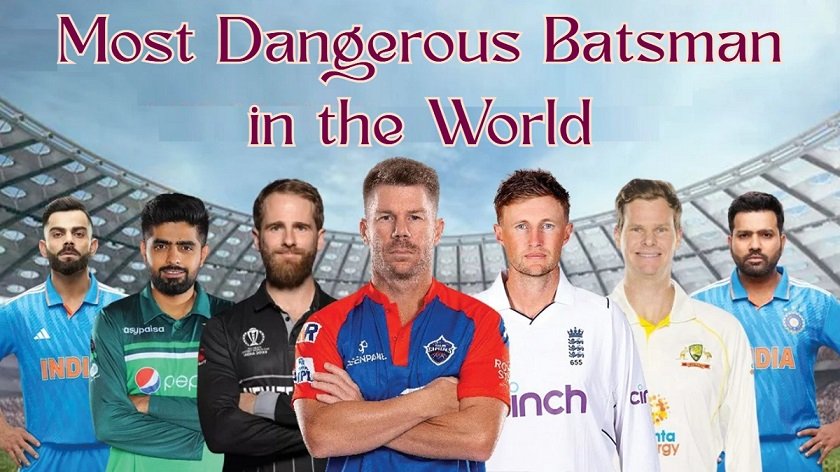
Most Dangerous Batsman in the World
The phrase “Most Dangerous Batsman in the World” is generally used in cricket to describe a batter who can alter the course of a match very quickly thru competitive stroke play, boundary hitting, consistency, strain handling, and the capability to score runs at a fast pace. There is no professional ICC award or everlasting ranking known as the “most dangerous batsman in international,” so the answer relies upon the standards being considered.
Over the years, numerous legendary batters have earned this description. AB de Villiers, Chris Gayle, Virat Kohli, Rohit Sharma, David Warner, Glenn Maxwell, Jos Buttler and many other players have produced innings that reveal specific sorts of batting threat.
Among the most famous examples, AB de Villiers stands out for his extremely good capacity to score rapidly in ODI cricket. He holds the statistics for the quickest ODI 50, 100, and 150, consistent with ICC statistics. He reached 50 in 16 balls, 100 in 31 balls, and 150 in 64 balls.
What Makes a Batsman Dangerous in Cricket?
A risky batsman isn’t always just a participant who hits the maximum sixes. Modern cricket has numerous factors that determine how much pressure a batter can place on a bowling attack.
Some essential characteristics include:
| Factor | Why It Matters |
|---|---|
| Strike Rate | Shows how quickly a batter scores |
| Boundary Hitting | Allows a batter to change the scoreboard rapidly |
| Six-Hitting Ability | Can dramatically change a match |
| Consistency | Helps produce runs regularly |
| Power Against Pace | Makes fast bowlers less effective |
| Ability Against Spin | Reduces the effectiveness of spinners |
| Shot Range | Makes it difficult for bowlers to set fields |
| Pressure Handling | Important in close matches |
| Big-Match Performance | Shows ability to perform under pressure |
| Adaptability | Allows a batter to succeed in different formats and conditions |
A batter who combines numerous of those features can end up extremely difficult for bowlers to govern.
AB de Villiers – One of Cricket’s Most Destructive Batters
When discussions turn to the most dangerous batsman in the world, AB de Villiers is one of the first names that comes up.
The former South African global has become famous for his progressive batting, incredible hand-eye coordination and capability to hit deliveries into areas that conventional subject settings could not without difficulty cowl.
His famous 2015 ODI innings against West Indies is one of the clearest examples.
De Villiers scored 149 from 44 balls in Johannesburg. During that innings, he reached his fifty from handiest 16 balls and his century from 31 balls. The ICC statistics those because the fastest ODI fifty and century at the time, and he later set up the fastest ODI one hundred fifty.
Only some weeks later, for the duration of the 2015 Cricket World Cup, he scored an unbeaten 162 from 66 balls against West Indies. He reached 150 from just 64 deliveries, a record that the ICC has highlighted as the quickest ODI 150.
Why AB de Villiers Was So Difficult to Bowl To
AB de Villiers had a strangely huge variety of shots. He ought to play conventional cricket photographs however was also capable of hitting in the back of the wicket, over the infield, and into unusual areas.
His capability to change his shot in the remaining moment made discipline placement mainly hard.
He may also build up extremely quickly. A batter attaining a century in 31 balls gives the opposition little or no time to recover once the momentum shifts.
For this reason, AB de Villiers is often blanketed in discussions about the most risky batsmen in cricket history.
Chris Gayle – The Universe Boss
Another player who merits fundamental interest in any dialogue about negative batting is Chris Gayle.
The West Indies left-handed opener constructed a popularity round of great sixes, physical energy, and attacking batting. His effect turned into mainly visible in T20 cricket.
Gayle scored the first men’s T20 World Cup century when he made 117 against South Africa in 2007. He later scored every other T20 World Cup century for England in 2016.
According to the ICC, Gayle’s 2016 century came off 47 balls, making it the quickest men’s T20 World Cup century until the document was surpassed at the 2026 event.
The 2026 Men’s T20 World Cup statistics show that New Zealand’s Finn Allen later scored a century from just 33 balls, moving in advance of Gayle’s 47-ball record.
Gayle’s recognition, however, extends beyond one file. His capability to clear the boundary constantly made him particularly dangerous in restrained-overs cricket.
Virat Kohli – Consistency and Match Control
Virat Kohli represents a one-of-a-kind type of dangerous batting.
Rather than relying exclusively on energy hitting, Kohli has constructed his reputation thru consistency, run chasing, fitness, shot selection and the capability to assemble large innings.
The ICC suggested that Kohli have become the 0.33 batter in ODI history to skip 14,000 ODI runs in February 2025, joining Sachin Tendulkar and Kumar Sangakkara in that group. At that point, he had 50 ODI matches and 73 fifties.
His overall performance at the 2023 Men’s Cricket World Cup additionally proved his ability to hold a high standard at some stage in a major match. Kohli scored 765 runs in 11 matches, such as three centuries and six half-centuries. The ICC recognized those 765 runs because the maximum by any man or woman batter in a unmarried guys’s Cricket World Cup version.
Kohli’s risk comes from greater than attacking pictures. His capacity to bat for long periods at the same time as retaining scoring pressure can force bowlers and captains into protective techniques.
Rohit Sharma – The Six-Hitting Specialist
Rohit Sharma is another batter regularly associated with explosive confined-overs batting.
His potential to hit sixes, mainly in opposition to tempo bowling, has been a prime part of his restrained-overs profession.
Rohit’s batting fashion combines timing with electricity. Instead of constantly counting on brute pressure, he can generate sizable distance with relatively convenient-looking strokes.
His capability to transform into huge ratings has also made him a vital white-ball batter.
Glenn Maxwell – The 360-Degree Attacker
Glenn Maxwell is another instance of a batter whose unconventional approach makes him hard to contain.
Maxwell is capable of playing photographs in the front of the wicket, in the back of square and over the sphere. His potential to attack both pace and spin offers captains fewer cushty bowling alternatives.
A tremendous example came during the 2023 Cricket World Cup, when Maxwell scored an exquisite unbeaten 201 against Afghanistan.
The ICC has additionally highlighted his 2023 World Cup century against the Netherlands, which came off 40 balls and turned into the fastest World Cup century by an Australian batter at the time.
Jos Buttler – Explosive Modern White-Ball Batter
Jos Buttler has also become one of the most recognizable aggressive batters in current constrained-overs cricket.
His batting combines energy, timing and a wide variety of unconventional shots. He can assault at some point of the powerplay but also can boost up dramatically for the duration of the middle and dying overs.
Buttler’s capacity to score quickly makes him mainly precious in T20 and ODI cricket, where the rate of scoring can extensively have an effect on the end result.
David Warner – Aggression From the Opening Overs
David Warner is another distinguished example of a competitive opening batter.
Opening batters face the new ball, but they also can make the most of field restrictions in confined-overs cricket. Warner has traditionally used attacking strokes to place strain on bowlers early.
His left-handed batting additionally creates a unique perspective for bowling attacks as compared with right-handed batters.
Suryakumar Yadav – Innovative T20 Batting
Modern T20 cricket has introduced a brand new category of risky batting, wherein batters are predicted to attack almost every type of delivery.
Suryakumar Yadav is an example of this technique.
His ability to play shots behind square, over the wicketkeeper and into uncommon areas has made him a distinguished T20 batter.
His batting demonstrates how contemporary cricket has moved beyond conventional attacking techniques. Rather than clearly hitting the ball tougher, present-day batters increasingly use angles and unconventional shot selection to disrupt area placements.
Comparison of Major Dangerous Batters
| Batsman | Main Strength | Notable Feature |
|---|---|---|
| AB de Villiers | Innovation and acceleration | Fastest ODI 50, 100 and 150 records |
| Chris Gayle | Power hitting | Two T20 World Cup centuries |
| Virat Kohli | Consistency and chasing | More than 14,000 ODI runs reached in 2025 |
| Rohit Sharma | Timing and six hitting | Powerful limited-overs opener |
| Glenn Maxwell | 360-degree batting | Exceptional ability against pace and spin |
| Jos Buttler | Power and range | Explosive white-ball batter |
| David Warner | Aggressive opening | Attacks from the beginning |
| Suryakumar Yadav | Unorthodox T20 shots | Wide range of scoring areas |
Who Can Be Called the Most Dangerous Batsman?
There is no single respectable solution due to the fact that “dangerous” can suggest different things.
If the principal criterion is fast ODI scoring, AB de Villiers has a first-rate case because of his record for the quickest ODI fifty, century, and 150. The ICC statistics his 31-ball ODI century and 64-ball ODI 150 as landmark performances.
If the criterion is T20 electricity hitting, Chris Gayle’s profession is one of the most outstanding examples, at the same time as later gamers together with Finn Allen have produced even quicker tournament centuries.
If the criterion is lengthy-time period ODI consistency and run accumulation, Virat Kohli’s file presents an extraordinary measure of batting hazard. His 14,000 ODI-run milestone in 2025 and his 2023 World Cup record demonstrate the dimensions of his ODI production.
Therefore, the phrase must be understood according to the unique batting first-rate being discussed as opposed to a reputable worldwide rating.
What Makes AB de Villiers Particularly Memorable?
AB de Villiers’ case is unusual due to the fact that several elements came together.
First, he should score at an extraordinary velocity. His 31-ball ODI century remains one of the most famous examples of acceleration in international cricket.
Second, he had a strangely extensive shot choice. Bowlers could not easily count on that a selected delivery could bring about a traditional shot.
Third, he turned out to be capable of playing both conventional and revolutionary cricket.
Finally, his performances got recognition at global degree. His 162 not out from 66 balls against West Indies throughout the 2015 World Cup remains one of the most superb World Cup innings.
Most Dangerous Batsman in the World: Key Records
The following records help explain why several gamers are often mentioned in this dialogue:
| Record/Performance | Player | Achievement |
|---|---|---|
| Fastest ODI century | AB de Villiers | 31 balls |
| Fastest ODI fifty | AB de Villiers | 16 balls |
| Fastest ODI 150 | AB de Villiers | 64 balls |
| 2015 World Cup explosive innings | AB de Villiers | 162* from 66 balls |
| Former fastest T20 World Cup century | Chris Gayle | 47 balls |
| 2026 fastest T20 World Cup century | Finn Allen | 33 balls |
| 2023 World Cup most runs in one edition | Virat Kohli | 765 runs |
| 14,000 ODI runs milestone | Virat Kohli | Third batter to reach the mark |
The information above shows why it’s miles tough to perceive just one participant using each viable definition of “risky.”
Difference Between a Dangerous Batsman and a Consistent Batsman
A dangerous batsman and a regular batsman aren’t necessarily the same.
A dangerous batter can also alternate a fit in a few overs. A consistent batter can also repeatedly score valuable runs across many innings.
For instance, a participant who scores 80 runs from 45 balls can dramatically regulate a T20 innings. Another participant may also score eighty from one hundred ten balls in a different layout and nonetheless make an essential contribution.
This is why strike rate, average, fit scenario, and format all want to be taken into consideration together.
Importance of Format
The identity of the “maximum dangerous batsman” also can exchange consistent with format.
Test Cricket
In Test cricket, endurance, method, attention, and the capability to address changing situations are extraordinarily essential.
ODI Cricket
ODI cricket requires a balance between accumulation and acceleration. Batters have to adapt to powerplays, middle overs, and loss of life overs.
T20 Cricket
T20 cricket places a much greater emphasis on fast scoring. A batter may have only a small wide variety of deliveries, making boundary percentage and strike rate especially crucial.
Therefore, a player who is extraordinarily risky in T20 cricket won’t necessarily have the identical impact in Test cricket.
Conclusion
The word “most dangerous batsman in the world” no longer has a legit ICC definition, so it’s far more understood as an outline of a batter’s ability to put exquisite strain on a bowling attack.
AB de Villiers is one of the strongest historical examples due to his incredible ODI acceleration and information for the quickest ODI fifty, hundred and a hundred and fifty.
Chris Gayle represents huge electricity and 6-hitting potential, especially in T20 cricket, while Virat Kohli demonstrates any other shape of danger through consistency, run accumulation and fit-winning ODI performances.
Other contemporary and recent-generation batters along with Rohit Sharma, Glenn Maxwell, Jos Buttler, David Warner and Suryakumar Yadav exhibit that unfavourable batting can take many exceptional bureaucracy