Introduction
Wicketkeeping is one of the most demanding talents in cricket. A wicketkeeper has to stay alert for every delivery, read the movement of the ball, expect the batter’s footwork, and react immediately while an possibility for a stumping appears. Some stumpings appear so speedy that spectators can barely understand what has befell earlier than the bails are already on the floor. Top 5 Fastest Stumping Record Time
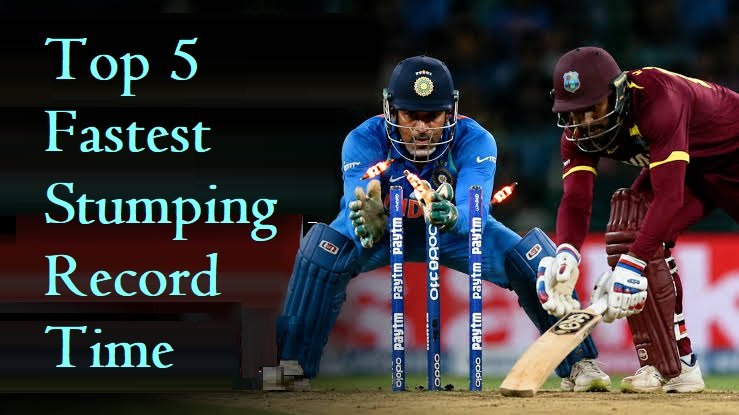
The keyword Top 5 Fastest Stumping Record Time is specifically popular among cricket enthusiasts due to the fact that MS Dhoni has produced several exceedingly brief stumpings in the course of his profession. His well-known dismissal of West Indies batter Keemo Paul in 2018 is broadly pronounced as a 0.08-2d stumping, making it the maximum normally noted fastest stumping in cricket.
However, there is an essential point to recognize before looking at the ratings: there may be no official ICC or Guinness World Records leaderboard that records every stumping by means of reaction time. The times commonly posted online are generally calculated or suggested from TV pictures and sluggish-motion replays. Therefore, those figures need to be described as suggested or broadcast-timed information in preference to professional statistical information.
What Is a Stumping in Cricket?
A stumping happens when the wicketkeeper legally breaks the wicket even as the batter is out of their crease and isn’t attempting a run. Usually, this happens when a spinner or any other bowler beats the batter’s attempt to play the ball, and the batter’s actions are outside the crease.
For a successful stumping, the wicketkeeper desires to:
- Collect the ball cleanly.
- Keep control of the ball.
- Remove as a minimum one bail or break the wicket with the ball.
- Ensure the batter has not regained their footing.
- Complete the action before the batter’s foot or bat is grounded at the back of the crease.
Because those actions manifest in fractions of a 2d, wicketkeeping calls for first rate hand-eye coordination and anticipation.
Top 5 Fastest Stumping Record Time
The following list represents commonly mentioned fast stumping times from cricket publications and professional cricket guides. Since there may be no official global database for stumping response instances, the ratings ought to be handled as stated timings instead of certified global facts.
| Rank | Wicketkeeper | Batter | Reported Time | Match/Format | Year |
|---|---|---|---|---|---|
| 1 | MS Dhoni | Keemo Paul | 0.08 sec | India vs West Indies, ODI | 2018 |
| 2 | MS Dhoni | Mitchell Marsh | 0.09 sec | India vs Australia, T20I | 2012 |
| 3 | Ben Cox | Callum McLeod | 0.10 sec | T20 Blast | 2018 |
| 4 | MS Dhoni | Shubman Gill | 0.10 sec | CSK vs GT, IPL Final | 2023 |
| 5 | Brendon McCullum | Ricky Ponting | 0.11 sec | ICC World Cup | 2011 |
Different resources, once in a while, put up barely one-of-a-kind scores or timings, particularly for domestic and IPL dismissals. For example, a few lists place Kumar Sangakkara and Adam Gilchrist among the subsequent fastest wicketkeepers.
1. MS Dhoni – 0.08 Seconds vs Keemo Paul
The most famous entry on the Top 5 Fastest Stumping Record Time list is MS Dhoni’s dismissal of West Indies all-rounder Keemo Paul.
The incident came about during India’s ODI collection towards the West Indies in 2018. Ravindra Jadeja turned into a bowler when Keemo Paul moved forward attempting to play the shot. The ball beat the batter, and Dhoni gathered it at the back of the stumps earlier than expected, dislodging the bails.
The suggested timing was just 0.08 seconds.
That record has been repeatedly stated in cricket courses because the quickest stumping associated with Dhoni and the fastest stumping in cricket history.
What made the dismissal mainly stunning was Dhoni’s anticipation. A wicketkeeper cannot rely only on reaction speed. Positioning, studying the batter, and predicting the ball’s path are similarly important.
2. MS Dhoni – 0.09 Seconds vs Mitchell Marsh
Dhoni appears once more at number two with another awesome stumping.
During India’s 2012 T20I against Australia, Mitchell Marsh got here forward to attack the stumps. The batter was crushed, giving Dhoni a possibility at the back of the wickets.
Dhoni completed the stumping in a pronounced 0.09 seconds.
The distinction between the first and 2nd entries is the most effective one-hundredth of a 2nd. This dismissal came several years before Dhoni’s famous 0.08- 2nd effort, displaying that his lightning-rapid wicketkeeping was not a one-off feat.
3. Ben Cox – 0.10 Seconds vs Callum McLeod
The third is particularly thrilling because it demonstrates that extraordinarily rapid stumpings are not confined to global cricket.
English wicketkeeper Ben Cox is broadly credited with a stated 0.10-2nd stumping of Callum McLeod in the course of the 2018 T20 Blast.
Although home cricket receives less global interest than foremost ICC tournaments, wicketkeepers can produce global-elegance moments in home competitions. Cox’s suggested timing is one instance.
Because home competitions do not now hold a standardized international stumping-pace database, this figure should also be seen as a said broadcast measurement in preference to a formally certified global document.
4. MS Dhoni – 0.10 Seconds vs Shubman Gill
MS Dhoni’s fourth look on usually posted fastest-stumping lists came at some point of the IPL 2023 final between Chennai Super Kings and Gujarat Titans.
Shubman Gill was turned into a brush-off by Dhoni after shifting out of his crease in opposition to Ravindra Jadeja. Dhoni reacted extraordinarily quickly, gathered the ball, and eliminated the bails.
The dismissal has generally been reported at about 0.10 seconds, despite the fact that a few sources have reported slightly different timings, which include 0.12 seconds. This difference illustrates why those figures ought not to be handled as reputable statistical records.
The second became especially notable because it took place in the IPL very last, where stress and concentration are at their highest.
5. Brendon McCullum – 0.11 Seconds
New Zealand wicketkeeper-batter Brendon McCullum also appears in numerous posted lists of the quickest stumpings.
A normally stated timing for one of his stumpings is approximately 0.11 seconds. McCullum was recognized for his athletic wicketkeeping and aggressive style, making him one of the most interesting wicketkeepers of his era.
Published rankings differ on the exact fit and timing for a few historical stumpings, so this entry should again be considered a suggested figure in preference to a universally certified file.
Why Is MS Dhoni So Famous for Fast Stumpings?
MS Dhoni’s wicketkeeping method became extraordinary compared to that of many conventional wicketkeepers. Several factors contributed to his first-rate velocity.
1. Anticipation
Dhoni became extraordinarily skilled at reading a batter’s movement. Instead of simply reacting after the ball had left the bat, he frequently appeared organized for the batter to leave the crease.
2. Hand Position
His gloves were frequently positioned close enough to the stumps to reduce pointless motion. Less motion meant much less time spent removing the bails.
3. Wrist Speed
Dhoni’s speedy wrist motion allowed him to gather the ball and spoil the wicket nearly simultaneously.
4. Experience
Years of retaining to elite spinners helped him understand variations in flight, turn, and tempo.
5. Balance and Footwork
A wicketkeeper needs brilliant stability. Dhoni’s capability to remain solid even while transferring laterally or ahead helped him complete stumpings without wasting motion.
How Are Fast Stumping Times Measured?
This is a crucial question whilst discussing the top 5 fastest stumping record time.
Unlike a 100-metre race, cricket no longer has a reliable stopwatch operator measuring every stumping. Television broadcasters can use slow-motion footage and video frames to estimate the c language among the ball achieving the wicketkeeper and the bails being dislodged.
Consequently, figures together with 0.08, 0.09 or 0.10 seconds ought to typically be defined as said or broadcast-replay timings. The IPL, ICC and different governing bodies hold authentic dismissal statistics, but they do not keep a customary leaderboard of wicketkeeper response times.
This difference is essential for all and sundry publishing cricket statistics online.
Fastest Stumping vs Most Stumpings
Fastest stumping time and total variety of stumpings are special data.
A wicketkeeper may have a large quantity of career stumpings with out acting in a list of the fastest stumping times. Conversely, a wicketkeeper should produce an extremely short dismissal while not having the best profession overall.
MS Dhoni is particularly special due to the fact that he blended longevity and outstanding velocity. ESPNcricinfo’s records display his massive contribution as a wicketkeeper throughout international cricket.
Other Famous Fast Wicketkeepers
Although Dhoni dominates many online lists, numerous other wicketkeepers have produced notably brief work behind the stumps.
Kumar Sangakkara
Sri Lanka’s Kumar Sangakkara turned into a fantastic wicketkeeper and batter. His name appears in several ancient lists of brief stumpings, demonstrating his terrific anticipation and glove work.
Adam Gilchrist
Australia’s Adam Gilchrist combined competitive batting with outstanding wicketkeeping. He became particularly powerful towards spinners and changed into being able to do away with the bails in no time.
Brendon McCullum
McCullum’s athleticism and aggressive approach made him an exciting wicketkeeper. His speedy stumpings remain memorable among cricket lovers.
Mark Boucher
South Africa’s Mark Boucher became one of the most prolific wicketkeepers of his generation. His brief palms and consistency made him a main asset to South Africa.
Why Fast Stumpings Matter in Cricket
A stumping can absolutely change the momentum of a fit. Spinners frequently try to tempt batters out of their crease due to the fact that a small movement ahead can create a possibility for the wicketkeeper.
In restrained-overs cricket, doing away with a longtime batter may be particularly valuable. A wicketkeeper who can capitalize on tiny mistakes offers the bowling group a further method of taking wickets.
A speedy stumping also demonstrates teamwork between the bowler and wicketkeeper. The bowler creates the opportunity, whilst the wicketkeeper needs to end the dismissal.
Important Facts at a Glance
| Topic | Information |
|---|---|
| Most commonly cited fastest stumping | MS Dhoni vs Keemo Paul |
| Reported time | 0.08 seconds |
| Opposition | West Indies |
| Format | ODI |
| Year | 2018 |
| Bowler | Ravindra Jadeja |
| Second commonly cited timing | 0.09 seconds |
| Batter in second entry | Mitchell Marsh |
| Key skill | Anticipation + glove speed |
| Are these official ICC reaction-time records? | No |
| How are timings generally obtained? | Broadcast/slow-motion replay estimates |
Conclusion
The top 5 fastest stumping record time list demonstrates simply how fast an elite wicketkeeper can react at the back of the wickets. MS Dhoni’s suggested 0.08-2nd stumping of Keemo Paul remains the most widely cited fastest stumping in cricket. His 0.09-2d dismissal of Mitchell Marsh and approximately 0.10-second attempt towards Shubman Gill further show why he is regarded as one of the best wicketkeepers in cricket history.
Ben Cox and Brendon McCullum additionally characteristic prominently in posted quickest-stumping lists, showing that outstanding wicketkeeping is not limited to 1 player or one country.